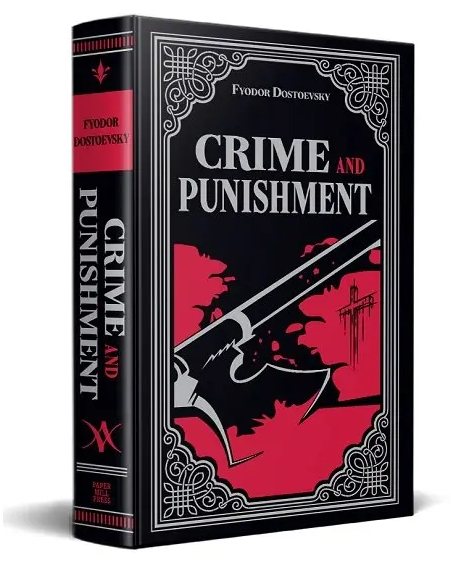
Crime And Punishment - Paper Mill Press
Only those capable of spiritual independence are worthy of great undertakings. Like Napoleon, who did not hesitate to open fire on an unarmed crowd, Raskolnikov, who admires the great man, places himself above ordinary mortals. The theoretical considerations that drive him to kill an old pawnbroker coexist and clash in the hero's mind, constituting the very essence of the novel. For Raskolnikov, the crime he is about to commit is simply justice toward humanity in general, and the poor who have been exploited in particular. "We accept being criminals so that the earth may finally be covered with innocents," Albert Camus would write. But this ideal of humanity sits uneasily with the sense of superiority that animates the hero; as a "superman," he is beyond good and evil. Planned with a cold-bloodedness tinged with mysticism, the murder nevertheless fails. The meager loot cannot satisfy his ideal of justice, while the crime, far from elevating him above the masses, degrades him among men. Raskolnikov will eventually surrender and accept his sentence; in doing so, he will achieve purification.